
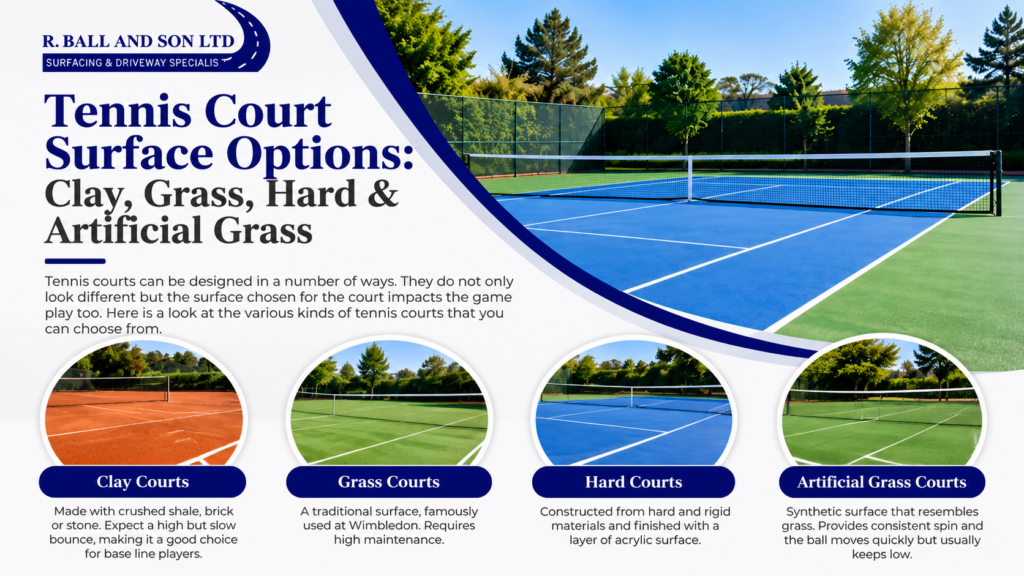
Tennis Court Surface Options: Clay, Grass, Hard & Artificial Grass
Tennis courts can be designed in a number of ways, and the surface chosen can influence far more than appearance. Ball speed, bounce and playing characteristics can all vary depending on the court surface.
Why Tennis Court Surface Choice Matters
Two tennis courts can look very different, but the surface also affects the way the game is played. Different materials influence how quickly the ball travels, how high it bounces and how consistently it reacts after making contact with the court.
Clay, natural grass, hard courts and artificial grass each provide their own playing characteristics. Understanding these differences can help when considering the type of tennis court surface that best suits the intended style of play.
R. Ball and Son Ltd also provides resin bound surfacing . Visit the service page to learn more about the company’s surfacing work.
Four Common Tennis Court Surface Types
The surface selected for a tennis court can produce noticeably different playing conditions. Here is an overview of four commonly used court surface types.
Clay Courts
Made using crushed shale, brick or stone and known for producing a relatively high but slower bounce.
Grass Courts
A traditional court surface made using natural grass and well known through tournaments such as Wimbledon.
Hard Courts
Constructed using hard, rigid material before being covered with an acrylic surface layer.
Artificial Grass Courts
Made using a synthetic surface designed to resemble grass and provide consistent playing characteristics.
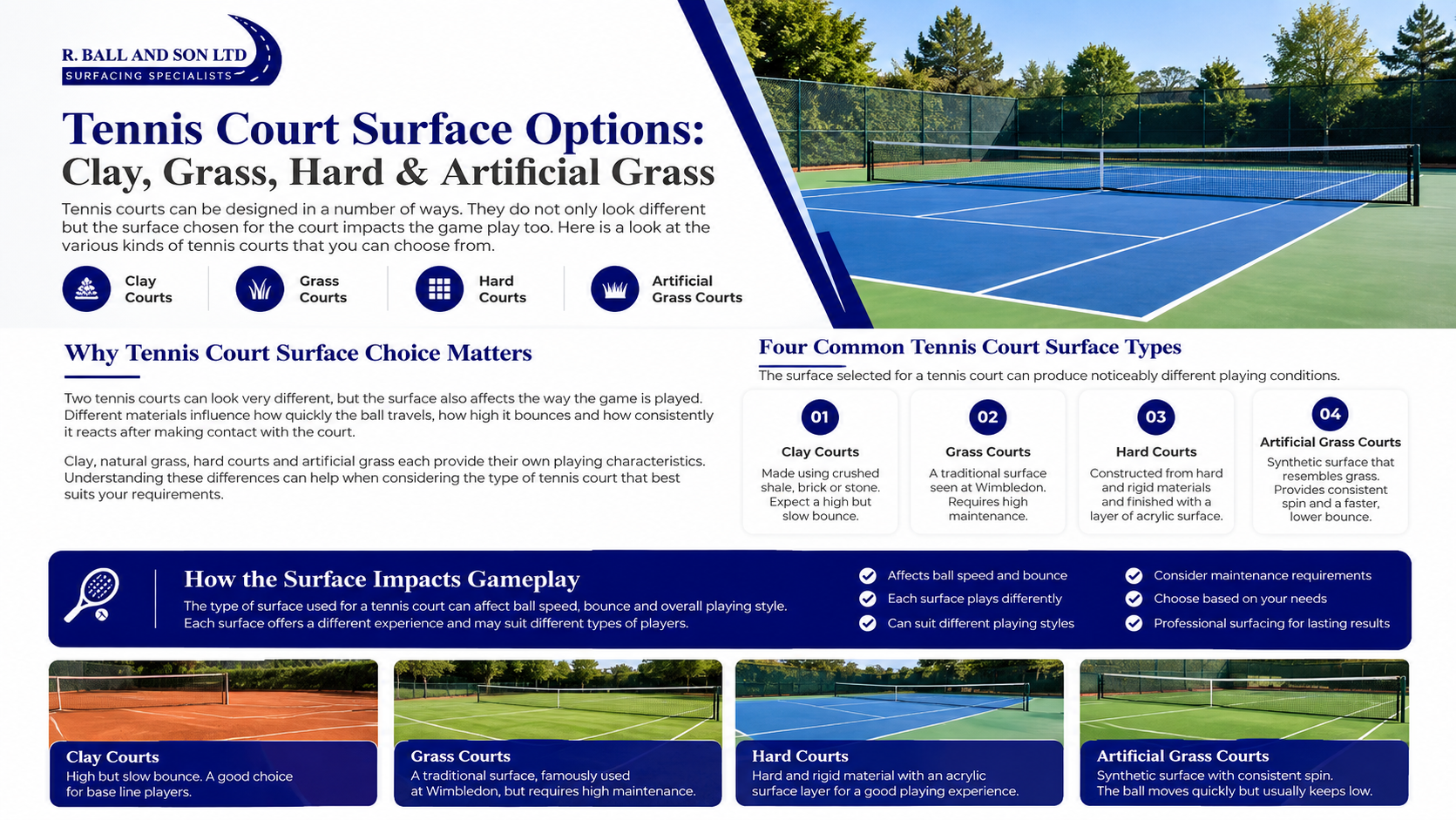
Clay Tennis Courts
Clay courts are constructed using materials such as crushed shale, brick or stone. Their playing characteristics are noticeably different from faster court surfaces.
Players can expect a comparatively high but slower bounce on clay. This gives players more time to react and can encourage longer rallies.
For this reason, clay can be particularly suited to baseline players who prefer to construct points from the back of the court.
Grass Tennis Courts
Grass courts have been part of tennis for a very long time and remain one of the sport’s most recognisable playing surfaces. Wimbledon is perhaps the most famous example of competitive tennis played on grass.
The traditional appearance of a grass court can be attractive, but natural grass requires considerable ongoing maintenance.
This maintenance requirement is one reason why some property owners and facilities may consider alternative tennis court surfaces.
Hard Tennis Courts
Hard courts are prepared using hard and rigid materials before being covered with a layer of acrylic surface.
This creates a purpose-built playing surface that provides a different playing experience from natural grass and clay courts.
When comparing tennis court options, both the appearance and playing characteristics of the finished surface are important considerations.
Artificial Grass Tennis Courts
Artificial grass courts use a synthetic surface designed to resemble natural grass. They provide a different playing experience from both traditional grass and hard courts.
One of the key characteristics of artificial grass is the consistent spin players can expect from the surface.
The ball can move quickly across an artificial grass court while generally remaining relatively low after the bounce. This creates a distinctive style of play compared with the slower, higher bounce associated with clay.
How Court Surfaces Change the Game
Surface choice has a direct influence on the way a tennis match develops. A player moving between clay, grass, hard and artificial grass courts may notice significant differences in ball speed and bounce.
These differences are why tennis court surfaces should not be selected purely on appearance. The type of playing experience required is also important.
- Clay provides a higher but slower bounce
- Natural grass provides a traditional playing surface
- Hard courts use a rigid base with an acrylic surface
- Artificial grass provides consistent spin
- Artificial grass generally keeps the ball relatively low
- Each surface creates its own playing characteristics
Clay vs Artificial Grass
Clay and artificial grass demonstrate just how different tennis court surfaces can be. Clay is associated with a high but relatively slow bounce, while artificial grass allows the ball to move quickly and typically remain lower.
This means players accustomed to one surface may notice a clear difference when moving onto the other.
Neither surface should be viewed simply as a visual design choice. Their playing characteristics are fundamentally different.
Natural Grass vs Artificial Grass
Natural grass and artificial grass may share a similar visual theme, but they are fundamentally different surfaces.
Natural grass has a long history in tennis and is famously used at Wimbledon. However, it requires relatively high levels of maintenance.
Artificial grass uses a synthetic material designed to resemble grass and provides consistent spin, with the ball typically travelling quickly and staying relatively low.
Hard Courts Compared with Other Surface Types
Hard courts are formed using rigid material and an acrylic surface layer, setting them apart from both loose clay surfaces and natural or synthetic grass.
The result is a different type of playing surface that may appeal to players looking for an alternative to clay or grass-based courts.
When comparing options, it is useful to consider how each surface behaves rather than considering appearance alone.
Quick Comparison of Tennis Court Surfaces
- Clay: high but slower bounce
- Grass: traditional natural surface
- Hard: rigid base with acrylic finish
- Artificial Grass: synthetic grass-like surface
- Artificial Grass: consistent spin
- Artificial Grass: faster, lower ball movement
Choosing a Tennis Court Surface
Choosing between clay, grass, hard and artificial grass means considering the type of playing characteristics required.
A baseline player may appreciate the slower, higher bounce associated with clay, while someone considering artificial grass should expect quicker ball movement and a lower bounce.
Natural grass remains a traditional option but requires significant maintenance, while hard courts provide another purpose-built alternative using rigid materials and an acrylic surface.
Consider Gameplay
Think about the bounce and ball speed associated with each surface.
Compare Surfaces
Review the characteristics of clay, grass, hard and artificial grass courts.
Consider Maintenance
Natural grass in particular is recognised for requiring considerable maintenance.
Choose the Right Option
Select the surface that best reflects the intended playing experience.
More About Resin Bound Surfacing
R. Ball and Son Ltd also provides resin bound surfacing services. If you are researching surfacing options for another exterior project, further information is available on the dedicated service page.
Visit the R. Ball and Son resin bound surfacing page to find out more.
Frequently Asked Questions About Tennis Court Surfaces
What are clay tennis courts made from?
Clay courts can be made using crushed shale, brick or stone.
How does a clay court affect the bounce?
Clay typically produces a comparatively high but slow bounce, making it a suitable surface for baseline players.
Why do some people avoid natural grass courts?
Natural grass courts require relatively high maintenance, which can lead some people to consider alternative surfaces.
How are hard courts prepared?
Hard courts use hard, rigid material covered with a layer of acrylic surface.
What is an artificial grass tennis court?
It is a court made using a synthetic surface designed to resemble natural grass.
How does the ball behave on artificial grass?
Artificial grass can provide consistent spin. The ball moves quickly but generally remains relatively low.
Explore Professional Surfacing from R. Ball and Son Ltd
Surface choice can have a significant impact on appearance and performance. If you would also like to learn more about R. Ball and Son Ltd’s resin bound surfacing service, visit the dedicated service page.
View Resin Bound Surfacing