
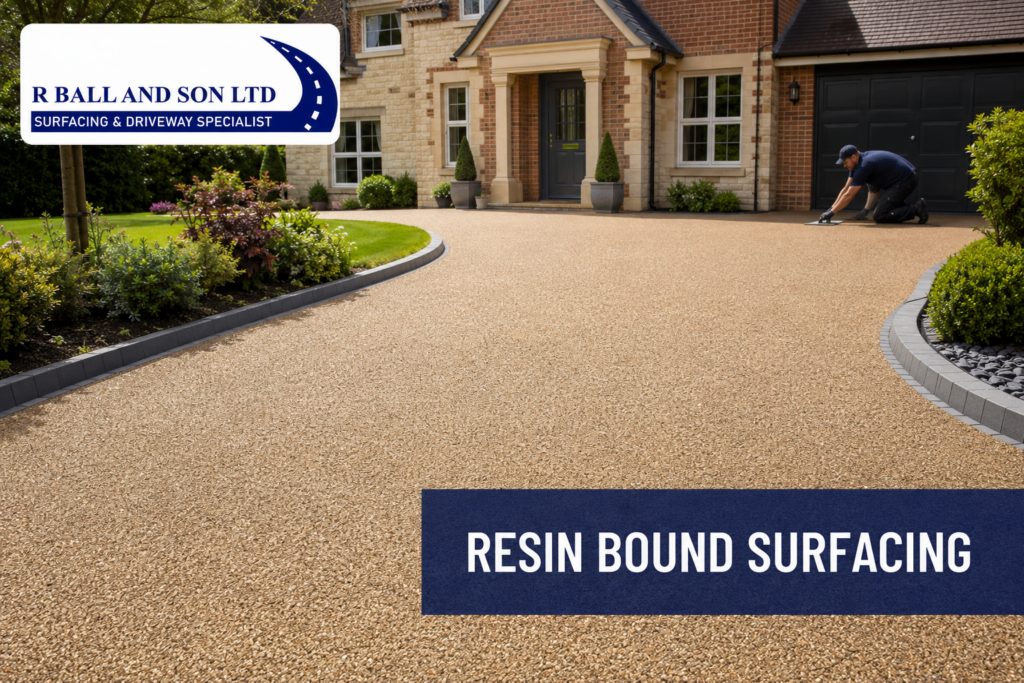
Choosing the right surface can significantly improve the appearance, safety and practicality of an outdoor area. Whether you are upgrading a driveway, pathway, patio, commercial entrance or sports facility, the material must be able to withstand regular use while complementing its surroundings.
Resin bound surfacing has become a popular choice for residential, commercial and recreational projects across the UK. It creates a smooth, decorative and hard-wearing finish that is available in a wide range of colours and aggregate blends. When professionally installed over a suitable base, it can provide an attractive surface designed for reliable long-term performance.
What Is Resin Bound Surfacing?
Resin bound surfacing is produced by thoroughly mixing natural aggregate stones with a high-quality clear resin. The mixture is then applied to a prepared base and carefully hand-trowelled to create a smooth, consistent finish.
Because every stone is coated in resin before installation, the completed surface remains bonded together while retaining small gaps between the aggregates. These gaps may allow water to drain through the surface into an appropriately constructed base below.
Resin bound surfacing should not be confused with resin bonded surfacing. With a resin bonded system, resin is applied directly to the base before loose aggregate is scattered over it. This creates a rougher, more textured appearance and does not provide the same level of permeability as a resin bound surface.
Benefits of Resin Bound Surfaces
Resin bound surfacing offers several advantages that make it suitable for many domestic and commercial environments.
Attractive Appearance
One of its most noticeable benefits is its clean and contemporary appearance. The surface is seamless, meaning there are no individual paving joints or large breaks to interrupt the finish.
Aggregates are available in numerous colours, sizes and combinations. This allows the design to complement traditional brickwork, modern architecture, garden landscaping or existing decorative features.
Contrasting borders, patterns and defined sections can also be incorporated to create a more personalised result.
Smooth and Accessible Finish
A properly installed resin bound surface provides a smooth and relatively even finish. This can make it easier to use for pedestrians, pushchairs, wheelchairs and bicycles than loose gravel or badly damaged paving.
Its textured construction can also provide useful grip under normal conditions. However, the correct aggregate, resin system and finish must be selected for the intended environment.
Permeable Construction
Many resin bound systems can form part of a permeable surface when installed over a suitable porous base. Rainwater can pass through the small spaces between the coated stones rather than remaining entirely on top.
This may help reduce puddling and manage surface-water run-off. However, permeability depends on the complete construction, not simply the decorative resin layer. An impermeable base underneath will prevent water from draining naturally through the system.
Durable Performance
When the preparation, materials and installation are appropriate, resin bound surfacing can withstand regular pedestrian and vehicle use. The bonded aggregate creates a firm surface that does not scatter in the same way as loose stone.
Its performance will depend on factors such as base stability, installation depth, traffic levels and ongoing maintenance.
Low-Maintenance Surface
Resin bound areas are generally straightforward to maintain. Routine sweeping can remove leaves, soil and loose debris, while occasional pressure washing at an appropriate setting can help keep the surface looking clean.
As there are no loose stones to redistribute regularly, it may require less everyday attention than a traditional gravel surface.
Where Can Resin Bound Surfacing Be Used?
The versatility of resin bound surfacing makes it suitable for many locations, including:
- Residential driveways
- Garden pathways
- Patios and seating areas
- Courtyards
- Entrance areas
- Commercial walkways
- Car parks
- Public spaces
- Schools and recreational facilities
- Swimming pool surrounds
- Cycle paths
- Selected sports surfaces
The exact construction must always be designed around the intended use. A pedestrian garden path will not require the same base specification as a driveway exposed to regular vehicle traffic.
Resin Bound Driveways
A resin bound driveway can create an attractive entrance while providing a firm and practical parking surface. Homeowners can choose an aggregate blend that coordinates with the property, boundary walls and surrounding landscaping.
Before installation, the existing driveway and underlying base should be assessed. In some cases, resin bound material can be applied over a suitable existing surface. However, cracked, unstable or contaminated bases may require repair or replacement.
Correct edging is also important because it supports the installation and creates a neat transition between the driveway and surrounding areas.
Resin Bound Paths and Patios
For garden paths and patios, resin bound surfacing can produce a seamless connection between different outdoor spaces. Its smooth finish can be used to create curved paths, defined seating areas and decorative borders.
The material can be installed around certain fixed features and shaped to suit more complicated layouts. This provides design flexibility for gardens where standard paving sizes may be restrictive.
A suitable colour combination can help the surface blend naturally with planting, stonework, fencing and other landscaping elements.
Is Resin Bound Surfacing Suitable for Tennis Courts?
Tennis courts can be constructed using several different surfaces, and each one affects ball speed, bounce and player movement.
Clay courts generally create a slower game with a higher bounce, while grass courts encourage faster play and a lower bounce but require considerable maintenance. Hard courts provide a consistent playing surface and are commonly finished with specialist acrylic coatings.
Resin bound surfacing may be suitable for certain recreational courts, surrounding paths, spectator areas and access routes. However, a competitive tennis court requires a specialist sports-surface specification designed to deliver the correct grip, ball response, durability and safety.
The intended level of play must therefore be discussed before selecting the system. A decorative resin bound product designed for driveways should not automatically be treated as a substitute for a purpose-built tennis court surface.
Preparing the Base for Installation
The finished resin surface is only as reliable as the structure beneath it. Poor ground preparation can lead to movement, cracking, sinking or drainage problems.
Preparation may involve:
- Removing loose or unsuitable materials
- Excavating to the required depth
- Installing and compacting a stable sub-base
- Creating suitable levels and falls
- Repairing defects in an existing base
- Installing secure edge restraints
- Checking drainage requirements
- Cleaning and preparing the application area
The base must be dry, stable and suitable for the selected resin system before installation begins. Professional assessment is essential because different projects may require different preparation methods.
The Resin Bound Installation Process
Once the base is ready, carefully measured quantities of aggregate and resin are mixed using specialist equipment. Accurate mixing helps ensure that every stone is coated consistently and that the material performs correctly.
The mixture is transferred to the prepared area, spread to the required depth and hand-trowelled by trained installers. The team works continuously to prevent visible joins and achieve a uniform finish.
Weather conditions must be suitable during installation. Rain, excessive moisture or unsuitable temperatures can affect the curing process and final result. After application, the surface must remain protected until it has cured sufficiently for pedestrian or vehicle use.
Maintaining a Resin Bound Surface
Regular maintenance can help preserve the appearance and performance of resin bound surfacing. Leaves, soil and other organic material should be removed to discourage moss or algae growth.
The area can be cleaned periodically using water and a suitable cleaning method. When using a pressure washer, the nozzle should be kept at an appropriate distance to avoid damaging the surface.
Oil, chemicals and other spills should be treated promptly using products suitable for resin bound materials. Harsh solvents or unsuitable cleaning substances should be avoided.
Heavy objects should not be dragged across the surface, and sharp metal items must be used carefully to prevent localised damage.
Why Professional Installation Matters
Resin bound installation requires accurate preparation, controlled mixing and skilled application. Even premium materials may perform poorly if the base is unsuitable or the resin-to-aggregate ratio is incorrect.
An experienced installer can assess drainage, traffic levels, base construction, edging and the most appropriate aggregate blend. Professional installation also helps create an even finish without inconsistent sections, loose stones or noticeable trowel marks.
Transform Your Outdoor Area with Resin Bound Surfacing
Resin bound surfacing offers an attractive combination of style, durability and practical performance. Its smooth appearance, broad colour selection and potential permeability make it suitable for driveways, paths, patios, commercial spaces and selected recreational areas.
The key to a successful installation is choosing the correct system and preparing the base properly. With professional planning, quality materials and experienced workmanship, a resin bound surface can provide a smart and long-lasting improvement to your property.
Contact our team today to discuss your resin bound surfacing requirements and receive advice on the most suitable design, aggregate blend and installation method for your outdoor space.
